Tuesday, September 15, 2009

The Ford Raptor is insane IMO and SVT has another hit on its hands. 13 inches of shock travel stock is insane. When the 6.2 liter is released in January with 400 HP and 400 ft lbs of torque. There has never been a more capable high speed off road truck to date. I liked the Lighning from SVT but this is really slick aluminum control arms and Fox racing shocks... well i let you read the reviews....

2010 Ford F-150 SVT Raptor Review


del.icio.us it Digg this Furl Google Bookmarks Live Favorites Reddit StumbleUpon Technorati Yahoo! This
Ford Full Sized Trucks Lyndon Conrad Bell 8/28/2009
When Ford's Special Vehicle Team (SVT) turns its attention to one of the company's vehicles, that ride inevitably runs faster, jumps higher and provides way more thrills per mile than the vehicle it's based on. And, in many cases, more than any other vehicle in its competitive set too. So, what happened when the SVT drew a bead on the new F-150?

Well, let's just call it focused mayhem.

The Ford F-150 SVT Raptor is the SVT's take on the pre-runner pickups desert racing teams use to scout the course ahead of unleashing their outrageously expensive Trophy Truck racers. A pre-runner has to be able to negotiate the same terrain as those racing trucks, at greatly elevated speeds like those racing trucks, and they can't break down in the process, again, like those racing trucks.

Recognizing a ripe opportunity to offer something truly unique in the marketplace, Jamal Hadeemi, SVT chief engineer and a former race engineer for a Baja Trophy Truck, set the SVT's engineers on a course to build a pre-runner for the real world.

Hadeemi's truck had to be capable of absorbing the punishing shocks to its system engendered by pounding over thousands of miles of rough terrain at speeds that would get you pulled over on any highway in America. However, it also had to provide an acceptable ride, competent handling and diminished levels of noise, vibrations and harshness so it could be employed as a daily driver.
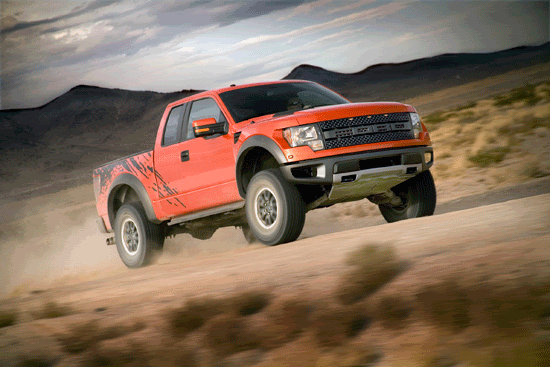
In other words, the Ford F-150 SVT Raptor had to be the offroad pickup equivalent of a high performance GT automobile. After spending a day driving it through the city streets of San Diego, over the sinuous roads scaling the Cuyamaca Mountains, and along miles of trails in the Anza Borrego desert, I can report the team has succeeded on all fronts. This is a truck you can drive back and forth to work everyday, and with no modifications whatsoever, take offroading in virtually any style you wish.

On pavement, the ride is (dare I say it?) plush, but reassuringly stable. Tire roar is non-existent, which, given the size and tread depth of those 35-inch desert boots the Raptor wears is an amazing accomplishment in and of itself. Body roll around curves is minimal and the steering is exactingly precise.

Taking to the dirt, if climbing steep inclines with loose gravel, sand, and/or snow under your wheels is your thing, Raptor offers over 11 inches of front, and 12 inches of rear suspension travel, along with four low gearing and locking differentials. In other words, Raptor SVT climbs like the proverbial mountain goat.
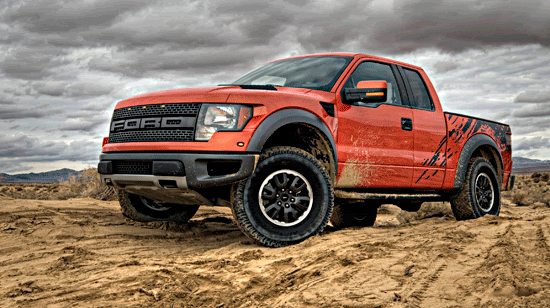
When it's time to descend those impossibly steep inclines, activating the F-150 Raptor's hill descent control eases you down that slope between two and 20 miles per hour (your preference) with only steering inputs required from you. The Ford modulates the downhill speed all by its lonesome.

Now if that style of offroad going is too slow for you, there's this whole other aspect to the Raptor's personality. While 320 horsepower moving nearly 6000 pounds might not sound like a whole lot on the street (and there is a 400 horsepower engine coming for the Raptor), in the desert, said 320 horsepower is more than adequate at keeping the Raptor ripping along at an eye-widening, white knuckling, booty puckering pace.

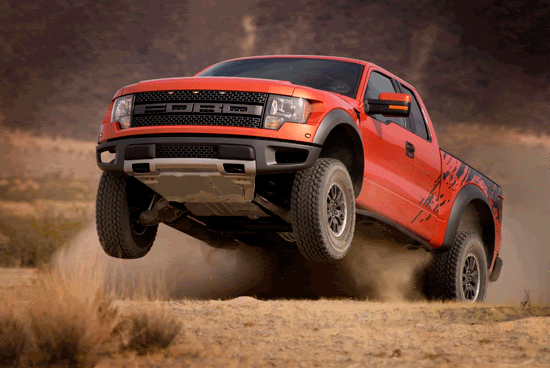
Thanks to key suspension modifications, the Raptor flies through the air with the greatest of ease, then lands as lightly as a ballerina. Much of this is due to the adoption of a set of oil-filled Fox triple interior-bypass shocks that firm up progressively and rebound progressively. This, combined with all of that suspension travel gives the shocks enough time to control the suspension system adequately as loads increase.
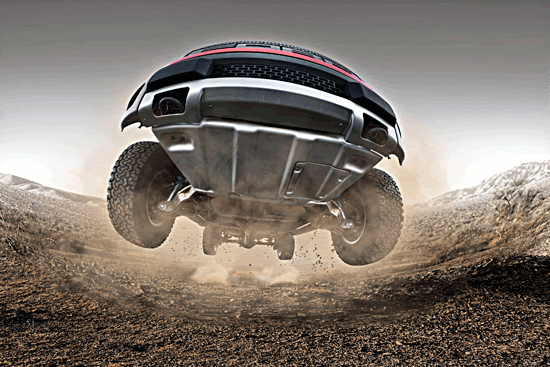
Readily adept at surfing sand dunes, flying (literally) over moguls, power sliding through desert washes with its tail hung out, all while sending gravel and dust flying in all directions at ferocious velocities - this is one badass pickup truck. Raptor is capable of screaming across the desert at speeds that would rip the suspension system out of any other pickup. That it does this is remarkable, that it does this and carries a factory warranty is absolutely amazing.

Back in the real world, Raptor offers a towing capacity of 6,000 pounds as well as a 1,000-pound payload capacity. Sirius satellite radio, Ford's Sync infotainment system, automatic climate control, supportive leather seating, and a nicely sculpted steering wheel provide welcoming accomodations.
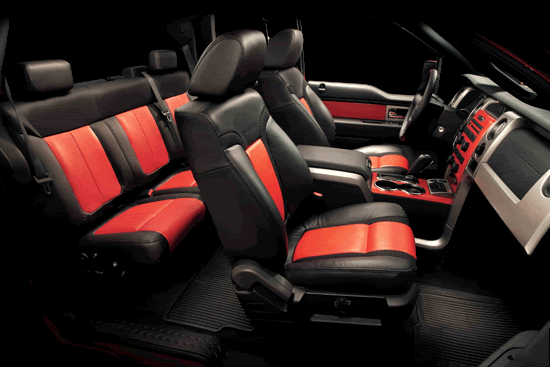
I've always been fond of Ford's interior treatments and the touches they've added to differentiate the Raptor really infuse the cabin with a sporting flair. Orange accents tell the world this is the fun loving F-150, and the black on white SVT six-gauge instrument package says it's serious about that fun too. All in all, this is an entirely new breed of factory pickup. It'll be interesting to see if GMC, Chevy and Chrysler decide to play along.
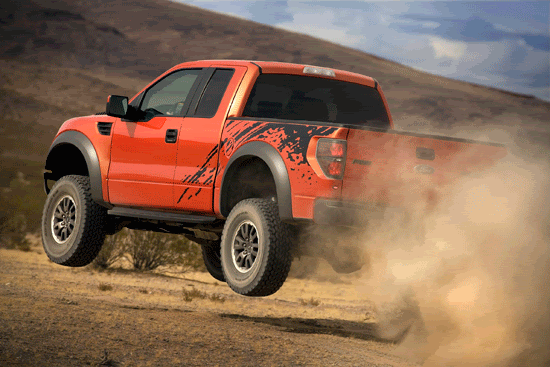
Ford F-150 Raptor SVT pricing starts at $38,995.


Popular Mechanics

April 24, 2009

CLICK TO ENLARGE
2010 Ford F-150 SVT Raptor

CLICK TO ENLARGE
2010 Ford F-150 SVT Raptor

CLICK TO ENLARGE
2010 Ford F-150 SVT Raptor

CLICK TO ENLARGE
2010 Ford F-150 SVT Raptor

CLICK TO ENLARGE
2010 Ford F-150 SVT Raptor
2010 Ford F-150 SVT Raptor Ride Review–Most Capable Pickup Ever? (With Video)
Ford Raptor

Borrego Springs, Calif.–The Raptor promises to be the most off-road-capable F-150 Ford has ever built. This pickup is like a street-legal Baja prerunner. In other words, the SVT Raptor promises to smooth out the worst high-speed desert terrain, fly over jumps and handle slow-speed four-wheeling better than just about any production truck. Tall order? Perhaps not.

We had a chance to spend a day riding along with the SVT team as they put a group of preproduction Raptors through an arduous development loop in the California dessert. So how does this truck handle extreme off-road conditions? Let's find out. –Ben Stewart

The Specs

The $38,995 Raptor is based on a 4WD F-150 Super Cab with a 5.5-foot bed. So there are quite a few components shared with the standard-issue F-150 range. Under the hood is Ford's 320-hp 5.4-liter V8 that generates 390 lb-ft of torque and is paired to a six-speed automatic. The differentials are conventional F-150. But an electronic locking rear differential is standard as are 4.10:1 gears that turn beefy 315/70R17 (35-inch) BF Goodrich All-Terrain T/A tires. And to cover the rubber, the bodywork skins are heavily flared.

Big tires are helpful to improve off-road ground clearance. But the key to the Raptor's capability is its suspension. The SVT team widened the F-150's track by 7-inches–measured at the center of the tire tread–with new upper and lower control arms. The lower control arms are chamfered like a skidplate, so rocks can slide underneath without hanging the truck up. The half-shafts, usually a weak link in independent front suspension 4WD trucks, are not only longer, but also more durable than the standard-issue units.

This added width gave engineers the platform to increase wheel travel. So now there's a total of 11.2-inches of travel up front and 13.4-inches in the rear. The suspension provides about an inch of lift too. To allow the Raptor to glide over obstacles and take the punishment of hard landings, the SVT team chose specifically tuned internal-bypass Fox Racing shocks and micro-cellular urethane bump stops.

Though the Raptor's 4WD system is mechanically similar to a standard-issue F-150, the SVT team incorporated advanced electronics to increase the capability. The stability control system has a sport mode that shuts off the traction control, and a "full off road" mode, that cuts all stability control functions and switches the ABS to an off-road setting. In full off-road mode, the electronic locking rear differential will remain locked at higher speeds too–so the Raptor acts like a prerunner with a spool for easy power slides. Like some modern off-road vehicles, the Raptor has a hill descent control system. But this system can match the speed you choose with the throttle, from 1.6-mph up to around 18 mph.

The Ride

It was pure torture. We had a full day with the Raptor on some of the best terrain in the California desert–and we were relegated to the passenger seat. Ford won't let anyone outside the development team behind the wheel of the Raptor until a drive event later this year. Still, we learned a lot riding shotgun.

The team used a 62-mile loop to both tune and validate the durability of the Raptor. In fact, they completed two full 1000-mile torture tests using this route. And every time the team returned to home base at the end of the loop, they hit a massive tabletop jump–clearing 2 to 3 feet under the rear axle. Sounds like a good day at the office to us.

From the right seat, it seems like that extreme tuning has paid off. SVT Vehicle Development Engineer Gene Martindale is a lead foot. He plants the throttle to the floor as we enter a sandy, rutted trail and doesn't lift when we approach berms and off-camber shelves. We grit our teeth and brace for the impact. But instead of crashing down onto the bump stops like an ordinary pickup might, the Raptor soaks it all up. It's not Cadillac-smooth–this is a truck after al≠l–but we've driven trails just like this in heavily-modified 4WD machines and, while many of them have had the wheel travel and ground clearance, rarely do they have the fine-tuned finesse of the Raptor.

As the desert opens up into a wide wash, our Raptor hits 80 mph and floats over the terrain. That speed would cripple most trucks out here, but the supple suspension takes the beating and feels remarkably stable too. High-speed desert romps are fun, but four-wheeling capability in low range requires a different set of vehicle skills. The Raptor may not have an ultralow transfer case like a Jeep Wrangler Rubicon or Dodge Power Wagon, but long-travel suspension kept the large tires in contact with the trail on one particularly hairy climb–and we crested the peak with the help of the rear locking differential.

The Bottom Line

The Raptor appears to have extraordinary off-road capability for a factory-tuned pickup truck. For those who want even more fun, a new 400-hp 6.2-liter V8 will be available after the initial Raptor launch this summer with 400 lb-ft of torque. We can't wait to slide behind the wheel of that truck.
Well...I guess ill post a little message about my favorite 5 door compact on the market right now. The 2010 Mazda Speed 3 there are a quite a few changes and it is a sexy machine. 263 HP and great torque it is the fastest car in its class beating the WRX, GTI, SI, etc etc... If you want a budget rocketship this is it. It can outperform most cars and still have room for golf clubs, luggage, or 20 cases of coke and 50 pizzas.


I like how it came in third behind Cobalt SS with less HP and torque and behind the GTI but they are good cars but the Speed3 goes from 0-80mph faster than anybody

First Look: 2010 Mazdaspeed3

New Happy Face, Same Rapid Pace
April 01, 2009
/ By Carlos Lago

In 2007, the Mazdaspeed3 was the most powerful front-driver under $25,000. Yet, it was the deft combination of power and utility that made the hatchback irresistible. The 2010 Mazdaspeed3, fortunately, relies on much of the previous generation's hardware -- engine included -- but gains Mazda's smiley-face aesthetics, an updated suspension and driveline, and reworked electronics to improve upon an already stout platform.

As with the standard Mazda3, Mazda's "Nagare" design language is apparent. The 2010 version receives a new lower airdam and hood scoop to differentiate it. The larger scoop improves intercooler airflow and frees enough real estate for a new intake duct; both upgrades, Mazda says, improve efficiency. Side skirts and larger exhaust tips complete the visual upgrades.

The wheels, sporting a design from the RX-8 R3, retain an 18-in. diameter but grow 0.5-in. in width. Tires follow, changing from Bridgestone Potenza RE050As to wider Dunlop SP Sport 2050s, sized 225/40R18. The wheels attach to MacPherson struts in the front and a multilink rear suspension, both with stiffer springs and higher dampening rates. There are new mounting points for the front stabilizer bar, and, for the rest of the suspension, thicker sheetmetal in high-stress areas, improving rigidity. Mazda claims a 2% increase in overall torsion stiffness.

The mechanical braking and hydraulic steering systems are no more. Mazda adopts electrical solutions to both, claiming greater flexibility in tuning. Rotors remain 12.6 in. up front and 11.0 in. at the rear, but now use an assist to combat driver hesitation during panic braking. The electric steering, Mazda says, is well weighted at high speeds, but not heavy when putting around parking lots.

Behind the steering wheel is the normal gauge cluster, augmented with a LED boost gauge. The rest of the interior wears black with red stitching and Mazdaspeed3 graphics on the semi-bucket front seats. Storage space grows slightly over its predecessor, to 17.0 cu ft. And, like on the standard Mazda3, an optional Tech Package includes push-button start, navigation, satellite radio, alarm, six-disc changer, and a five-channel Bose sound system.

The 263-horse turbo 2.3L carries over, but mates to a transmission with taller gears from second to fifth. With 280 lb-ft at 3000 rpm, torque steer is the enemy. Mazda combats it with a torque-sensing conical limit-slip and recalibrated torque-management system, which limits power based on gear and steering input.

Despite being one of the oldest in our "Small, Fast, Fun" comparison, the last Mazdaspeed3 clinched third thanks to incredible torque and driving feel. For 2010, Mazda appears to have only improved on the Speed3's strong points.


Here is an Edmunds review about the Mazda 3 it is the class leader IMO

Bigger, Better, More Powerful

STORY TOOLS
Digg this storyDigg this!
del.icio.usdel.icio.us

Think "evolution" not "revolution." That's what Ruben Archilla, group manager of research and development at Mazda North American Operations, tells us about the 2010 Mazda 3. Our translation: Don't fix it if it ain't broke.

With sales of the 2009 Mazda 3 still high and the car widely recognized as a class leader, the idea of fully revamping it is kind of questionable anyway. The 2010 Mazda 3, then, is a complete restyling with just enough mechanical updates and new features to freshen up its feel and bump up its amenity count.

You know, more of all the stuff that already sets the Mazda 3 apart from those lowly cheap-and-cheerful cars in the compact sedan category.

More Power and Better Economy?
For the new model year, the 2010 Mazda 3 is once again available in two trim levels — "i" or "s" — determined by engine displacement. The Mazda 3 i is equipped with a 2.0-liter inline-4 engine while the Mazda 3 s now receives the 2.5-liter inline-4 introduced by the 2009 Mazda 6.

The big news, of course, is the addition of the 2.5-liter engine to the Mazda 3 model mix. Once it's installed in the Mazda 3, this 2.5-liter MZR inline-4 is rated at 167 horsepower and 168 pound-feet of torque — a bump of 11 hp and 18 lb-ft over the former 2.3-liter mill. It's also 28 hp and 40 lb-ft more than the Honda Civic's 1.8-liter inline-4.

A six-speed manual transmission replaces the five-speed as standard equipment in s models and a five-speed automatic is optional.

Meanwhile the i model's 2.0-liter inline-4 remains virtually unchanged and is rated at 148 hp and 135 lb-ft of torque. It comes standard with a five-speed manual but can now be had with a five-speed automatic instead of only a four-speed automatic.

But here's the really good news. Every combination of engine and transmission in the 2010 Mazda 3 earns the same or better city/highway fuel economy as the current car. The s model equipped with a manual transmission is rated at 21 mpg city and 29 mpg highway, while the i model with manual transmission is rated at 25 mpg city and 33 mpg highway. In comparison, the Honda Civic EX sedan earns 26 mpg city/34 mpg highway when equipped with a manual transmission.

Bigger and (a Bit) Heavier
Although the revised car's wheelbase remains the same at 103.9 inches, the front and rear overhangs increase marginally to bring total length of the 3 s sedan to 180.9 inches. That's 3.6 inches longer than a Honda Civic sedan and 2.2 inches longer than a Toyota Corolla sedan.

Because the additional length is a result of a larger fuel tank on s models and a new muffler layout, the increase in interior space is only nominal. Trunk space is 11.8 cubic feet — about a half cubic foot less than Toyota's Corolla sedan, although slightly larger than the current 3.

To minimize weight, Mazda used high-tensile steel in specific areas of the 3's chassis. This change increases bending rigidity by 7 percent over the current car, while torsional rigidity remains the same. The new materials lighten the chassis by about 24 pounds.

Even so, it seems all new cars are heavier thanks to greater levels of safety and convenience features, and the 3 hasn't escaped this pitfall. Depending on trim and option fitment, the 2010 Mazda 3 will weigh between 58 and 111 pounds more than the current car. A Mazda 3 s equipped with the automatic transmission weighs 3,025 pounds, which is not a small number in the compact sedan category.

On the Road
Behind the wheel of the s model, the newfound power of the 2.5-liter engine and additional cog of the six-speed manual are welcome additions. With steering response and feedback rivaling the sports cars from many manufacturers, the 2010 Mazda 3 clearly retains the dynamic credentials it has inherited from the current car.

There's a sense of tautness in all of the 3's responses. Every control — steering, throttle response and brakes — feels as if it has been tuned by someone who knows and cares about driving. In particular, steering feel and response are outstanding; plenty of information passes through to the driver without relying on artificially high effort. Moreover, the chassis eats midcorner bumps with confidence while the brake pedal offers immediate effectiveness.

Changes beneath the Mazda 3's skin are relatively minor. Small geometry tweaks have been made to reduce understeer and increase rear grip. Three mounts now locate the steering rack instead of two, and the locating points for both the front and rear antiroll bars are farther apart for better effectiveness. The tire brands are new, but the size hasn't changed; 205/55R16 for the i model or 205/50R17 for the s model.

Damping and spring rates are well matched to produce excellent wheel and body control without overly compromising ride quality. The 3's ride is busier than that of a Civic EX or Corolla, but the return in feel and response makes the sacrifice worthwhile. This calibration makes the Mazda 3 a refreshing standout in a segment dominated by underdamped, slow-steering fuel misers.

Driver-Oriented Cockpit
One design priority in the 3's revised interior has been to orient all primary controls to the driver.

As before, the speedometer and tachometer dominate the instrument cluster, but the big change comes from a mid-dash recess above the center stack. A multi-information display (or a screen for the optional navigation system) is on the left, and a display for the ventilation and audio systems is on the right. This layout positions the speedometer and tachometer in the same visual plane, which has been our biggest beef with the Honda Civic's two-tiered design.

The Mazda's navigation system features a smaller screen relative to its current competitors. It's controlled by buttons mounted on the right-hand spoke of the steering wheel, and we found it intuitive enough to figure out without doing any reading. The goal of using a small screen, we're told, is to reduce the cost of the optional system to be more competitive with portable navigation units — an admirable but difficult task. Mazda expects the option to be priced at about $500, which should help it find more buyers than the current $1,500-$2,000 systems.

In addition to the controls for the navigation system and trip computer, the steering wheel also incorporates buttons for the audio system, Bluetooth and cruise control. There's also an efficient three-knob/five-button arrangement for the dual-zone climate control system.

The New Look
One criticism of the current Mazda 3 has been its fuel economy, which is marginally lower than some of its competition. Since the 2010 Mazda 3 has both more power and more weight, it doesn't seem like a recipe for better fuel economy. The answer? Make it slick.

As a result, the 2010 Mazda 3 is now more aerodynamic than any car in its class, featuring a 0.29 Cd. Though the new grille opening has been styled to look huge, it's actually smaller than on the current model. Look closely and you'll see that half the grille is just there for visual effect, not to admit air to the engine compartment. It's been carefully designed to meter in only enough air to accommodate cooling and combustion needs, while the rest of the air is routed over and around the body.

Much time was spent in the wind tunnel minimizing wind noise intrusion into the cockpit and it's obvious from behind the wheel, as the new 3 is one quiet machine. With the exception of the dual exhaust — a feature that has never made sense to us as part of a car powered by a four-cylinder engine — the design is largely purposeful.

Features Galore
The new 3 offers an abundance of amenities never before offered in the compact segment. Bi-xenon, self-leveling adaptive headlamps, push-button start and a driver seat with a three-position memory setting are all now on the options list.

A Bose 10-speaker surround-sound system as well as iPod connectivity, Bluetooth, heated seats and rain-sensing wipers are also available.

Side and curtain airbags are standard across the model range. Stability and traction control remain an option.

This is a real sedan, not a stripped-down economy car.

The Bottom Line
Mazda hasn't yet announced pricing for the 2010 Mazda 3, but it insists the new model will remain as competitively priced as the current car when it goes on sale in the beginning of 2009. A five-door model, which Mazda is yet to reveal, will go on sale at the same time.

With numerous innovative options, class-leading dynamics, engaging driving character and a new look, the 2010 Mazda 3 seems set once again to claw its way to class leadership. It might not be a revolution, but it clearly ain't broke.

Edmunds attended a manufacturer-sponsored event, to which selected members of the press were invited, to facilitate this report.